
Understanding the dental bonding process helps you feel confident before your appointment. At The Dental Care Group, we’ve refined our bonding procedure to deliver beautiful results efficiently—typically in under an hour per bonded tooth. Most patients are surprised by how quick and painless dental bonding is. There’s no drilling, usually no anesthesia, and you walk out the same day with a transformed smile.
Questions about the bonding process? Call our Aventura dental clinic at (305) 935-4991, our Pembroke Pines dental clinic at (954) 432-2020, or our Fort Lauderdale dental clinic at (954) 527-5515.
Our experienced cosmetic dental team explains every step in your preferred language: English, Spanish, Hebrew, Portuguese, Creole/Haitian, or Russian.
Meet Your Bonding Team at The Dental Care Group
Our cosmetic dental professionals have performed thousands of dental bonding procedures. We understand the nuances that create naturally beautiful results. We take the time to assess your needs, select the perfect composite resin color, and meticulously shape and polish your bonding.
With three convenient South Florida locations in Aventura, Pembroke Pines, and Fort Lauderdale, quality cosmetic dental care is always accessible. Our Saturday hours serve families and professionals who need flexibility in scheduling.
We serve our diverse South Florida community in multiple languages. Clear communication throughout your bonding procedure means you understand each step and feel comfortable from consultation to completion.
Step 1: Initial Consultation and Assessment
 Your bonding journey begins with a consultation. Your dentist examines the teeth you want treated and evaluates their condition. This assessment determines whether dental bonding is appropriate or if other cosmetic procedures might serve you better.
During this examination, your dentist checks for underlying issues:
- Active tooth decay must be treated first
- Gum disease should be brought under control
- Extensive structural damage may need crowns instead
- Chipped, cracked teeth that are too damaged need alternatives
Your dentist will ask about your aesthetic goals. Together, you’ll review before-and-after photos of similar cases. This gives you realistic expectations of what the bonding procedure can achieve. Talk to your dentist about any concerns with your current smile.
Step 2: Shade Selection and Color Matching
Selecting the right composite resin shade is critical for natural-looking results. Your dentist uses a shade guide—a set of tooth colored tabs arranged by hue—to determine which shade matches your natural teeth.
The shade selection process considers multiple factors:
- Varying degrees of translucency throughout the tooth
- Biting edges that appear more translucent
- Body of the tooth near the gum line
- Lighting conditions
- Color of surrounding teeth
Important timing note: If you’re planning to whiten your teeth, complete whitening before dental bonding. The bonding material doesn’t respond to whitening agents the way tooth enamel does. This ensures your bonded tooth matches your other teeth perfectly.
Step 3: Tooth Preparation and Conditioning
Unlike veneers or crowns that require significant enamel removal, the dental bonding process requires minimal tooth preparation. Your dentist begins by cleaning the surface of the tooth to remove any plaque or debris. This keeps your mouth healthy and ensures the bonding material adheres properly.
The tooth’s surface is then lightly roughened using a gentle etching gel containing phosphoric acid:
- Creates microscopic pores in the enamel
- Increases surface area for bonding
- Helps the bonding material mechanically lock into place
- Remains on the tooth for 15-30 seconds before rinsing
The phosphoric acid treatment is painless. You won’t feel anything during this step.
A conditioning liquid or bonding agents are applied to the prepared tooth surface. This primer soaks into the microscopic pores. It provides a stronger bond between your tooth structure and the composite resin. The conditioning liquid helps the bonding material adhere securely to create lasting results.
Step 4: Composite Resin Application and Sculpting
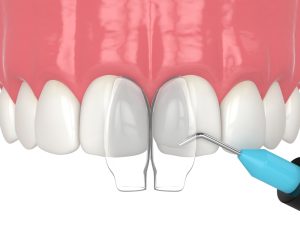 The composite resin arrives in a putty-like consistency. Your dentist can mold and shape this tooth colored resin to the desired shape. Rather than applying all the bonding material at once, your dentist works in thin layers. This builds up the restoration incrementally.
Each layer is carefully shaped using specialized dental instruments before being cured:
- For chipped teeth or broken edges, the bonding material extends beyond the natural tooth structure
- For gap closure, tooth colored resin is applied to the sides of adjacent teeth
- For discolored teeth, an opaque base layer masks the underlying color
- Translucent top layers create natural depth
Throughout the sculpting process, your dentist frequently steps back. They view the restoration from different angles and compare it to your surrounding teeth. This attention to detail ensures your bonded tooth looks completely natural.
Step 5: Curing and Hardening
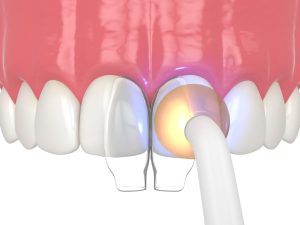 Once a layer of composite resin is shaped to satisfaction, it must be hardened. Your dentist uses a special light that emits high-intensity blue light at a specific wavelength.
The special light activates photoinitiators in the bonding material. This triggers a chemical reaction. The light activates the material and transforms the putty-like composite resin into a hard, durable solid in seconds. Your dentist holds the curing light close to your tooth, typically for 20-40 seconds per area.
You may notice the light feels slightly warm during curing. It shouldn’t cause discomfort. Some patients find the bright blue light intense even with eyes closed, so protective eyewear may be provided.
Step 6: Shaping, Trimming, and Contouring
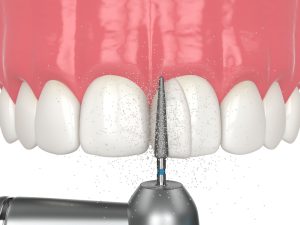 Once all composite resin layers are applied and cured, the detailed finishing work begins. Your dentist uses fine diamond burs and abrasive discs to trim away any excess material and refine the shape. This creates final adjustments to ensure comfort and appearance.
Key refinement areas include:
- Margins where bonding meets natural tooth structure
- Biting surface and sharp edges
- Front teeth biting edge to match your other teeth
- Sides of bonded tooth for natural emergence
- Contact points with adjacent teeth
Your dentist asks you to bite together gently. They check for any high spots that might cause premature contact. If you notice sharp edges or rough areas, your dentist will smooth them immediately. The goal is to make the bonded tooth feel exactly like your natural teeth.
Step 7: Polishing for a Natural Luster
The final step in the dental bonding process is polishing. Even though the composite resin is smooth after curing, it requires extensive polishing. This achieves the glossy, light-reflective surface of tooth enamel.
Your dentist uses a series of progressively finer polishing discs, rubber cups, and paste. This multi-step process removes microscopic scratches and creates an increasingly smooth surface.
Special attention is given to:
- Areas between teeth and near the gum line
- Creating imperceptible transitions with natural tooth structure
- Matching the gloss of surrounding teeth
- Smooth feel when running your tongue over it
A high polish not only improves aesthetics but also helps your bonding resist stains. Smooth surfaces resist stains better than rough surfaces. This is a critical final step to ensure your bonding material looks beautiful and lasts longer.
Step 8: Post-Procedure Instructions and Immediate Care
Before you leave the office, your dentist provides specific instructions. While you can eat and drink immediately since the bonding material is fully hardened, some precautions help maintain optimal results.
First 48 hours precautions:
- Avoid highly pigmented foods and beverages (coffee, tea, red wine, berries, tomato sauce)
- Refrain from smoking or using tobacco products
- Avoid biting hard foods while adjusting to your new tooth contour
- Avoid biting your nails or chewing on ice
- Contact your dentist if roughness persists or the bite feels uncomfortable
Your bite should feel normal immediately after the bonding procedure. If you notice any areas where your teeth hit prematurely or uncomfortably, call for a quick adjustment.