

Overjet vs Overbite: What’s the Difference and When Is Invisalign Right for You?
Dental Care Group Invisalign Care, Customized for Every Smile
You’re researching Invisalign. The words “overbite” and “overjet” keep popping up, but you don’t understand the difference. One ortho says you have no overjet, just a deep overbite. Another mentions how far your top teeth stick out. You look in the mirror and wonder which one you actually have and what it means for fixing your smile.
 The Dental Care Group is Here to Help.
Dr. Mars holds Diamond Invisalign Provider status, placing him in the top 1% of all Invisalign providers nationwide. He is the only Invisalign provider in both Broward and Miami-Dade County, has lectured on advanced Invisalign technique throughout the world, and has completed more than 4,000 successful cases. No two treatment plans at the Dental Care Group are alike. Dr. Mars works directly with every patient from their first appointment through their final aligner, using the latest digital technology to maximize results.
To schedule your Invisalign consultation with Dr. Mars, call our Aventura dental office at 305-935-2797, our Pembroke Pines dental office at 954-430-2300, or our Fort Lauderdale dental office at 954-963-3706. Our team is happy to answer any questions and help you find a time that works for you.
Defining Overbites and Overjets
Before exploring treatment, it helps to understand what sets these two types of malocclusion apart. Both involve the upper and lower teeth failing to meet in proper alignment, but they differ in the direction of that misalignment. The self-check below can help you identify which one you may be dealing with before your visit.
Quick Self-Check Guide
- Overbite: Bite down gently. Do your upper front teeth significantly overlap your lower front teeth vertically, covering more than 30% of them? That is an overbite.
- Overjet: Look in a mirror. Do your upper front teeth jut forward horizontally past your lower teeth? That is an overjet.
What Is an Overbite?
An overbite occurs when the upper front teeth overlap the lower front teeth excessively in a vertical direction. An overlap of 1 to 2mm is considered normal. Problems arise when the overlap deepens beyond 3 to 4mm or exceeds 30 to 40% coverage of the lower teeth. This severe overlap may be called a “deep bite.”
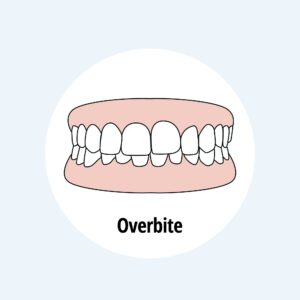 Signs you may have a significant overbite:
- Your upper front teeth substantially cover your lower front teeth when you close your mouth
- Your lower teeth make contact with the roof of your mouth
- You notice wear on the backs of your upper front teeth or the tops of your lower teeth
- Your smile has a gummy appearance, or your chin looks slightly recessed
- You experience jaw pain, clicking, or tension around the jaw joint
What about underbites? An underbite is the reverse condition, in which the lower teeth extend in front of the upper teeth when biting. Where overbites involve excessive downward coverage, underbites create a protruding lower jaw appearance and can contribute to chewing difficulty, speech changes, and jaw strain. Depending on severity, Invisalign may be a viable option for mild to moderate underbites as well.
What Is an Overjet?
An overjet is a horizontal protrusion of the upper front teeth beyond the lower teeth. A normal overjet measures approximately 2 to 3mm. When that gap exceeds 4mm, it is considered clinically significant, and severe overjets of 7mm or more often benefit from earlier intervention.
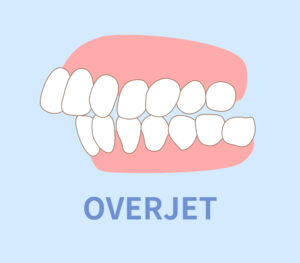 Signs you may have a significant overjet:
- Your upper front teeth visibly protrude forward at rest or when smiling
- There is a noticeable horizontal gap between your upper and lower teeth when biting
- You have difficulty fully closing your lips over your teeth
- You had a history of prolonged thumb-sucking or pacifier use as a child
Overbites and overjets are not mutually exclusive. A patient can present with both simultaneously, which is common and entirely treatable.
What Causes Malocclusion?
Malocclusion, the clinical term for any misalignment of the teeth or jaws, typically develops from a combination of genetic and environmental factors. Knowing the underlying cause helps Dr. Mars build an Invisalign plan that addresses not just your current alignment, but the conditions that contributed to it.
Overbite Causes
- Genetics
- Childhood oral habits: Prolonged thumb-sucking, pacifier use beyond age three, or tongue thrusting
- Missing lower teeth: Tooth loss in the lower arch can cause the upper front teeth to drop further over time
- Teeth grinding (bruxism)
- Nail biting or chewing on hard objects
- Lapsed orthodontic retention: Not wearing retainers after braces can allow the bite to shift back
Overjet Causes
- Genetics
- Prolonged thumb-sucking or pacifier use: Use past ages three to four is especially linked to horizontal protrusion of the upper front teeth
- Mouth breathing: Often resulting from allergies or enlarged adenoids, it alters tongue posture and can disrupt jaw development
- Tongue thrusting: A swallowing pattern in which the tongue pushes forward against the front teeth, gradually pushing them outward
- Missing upper back teeth
- Skeletal jaw discrepancy: A recessed lower jaw creates the appearance of protruding upper teeth, even when the upper tooth position is normal
What Happens If I Don’t Treat My Misaligned Bite?
A minor overbite or overjet that is not causing symptoms may not require immediate treatment. The clinical picture changes as the degree of misalignment increases or progresses over time. The guide below can help you understand at what point treatment moves from optional to genuinely important.
When Is Overbite or Overjet Treatment Recommended?
- Mild (1 to 3mm overbite/2 to 4mm overjet): Monitor annually. Treatment is elective at this stage.
- Moderate (3 to 5mm overbite/4 to 6mm overjet): Treatment is recommended to prevent progressive wear and jaw strain.
- Severe (over 5mm overbite/over 7mm overjet): Prompt treatment is strongly advisable. Function and long-term dental health are at meaningful risk.
Consequences of Not Treating My Overbite
-
- Accelerated tooth wear: The lower front teeth repeatedly contact the backs of the upper front teeth, eroding enamel on both
- Palate damage in severe cases
- TMJ disorders, including clicking, pain, and reduced range of motion
- Gum recession and periodontal concerns
- Difficulty chewing and speech changes
Consequences of Not Treating My Overjet
- Increased injury risk: Protruding front teeth are substantially more vulnerable to trauma from falls, sports, and accidents
- Chipping and fracture
- Lip incompetence: The lips may not close comfortably at rest, increasing dry mouth and gum disease risk
- Airway and breathing problems, including snoring
- Speech difficulties and progressive worsening without correction
 Orthodontic Treatment for Looks, Health, or Both? It Is Your Call.
Not every patient wants the same outcome, and Dr. Mars does not treat them like they do.
Orthodontic care used to come with one default assumption: correct everything, fully, to clinical standard. That is not how we work. Many of our patients have grown up with a mild overbite or slight protrusion that feels like part of who they are. They want to protect their dental health, reduce long-term wear, or address a functional concern without changing the thing that makes their smile theirs. We see that as a completely reasonable goal.
Dr. Mars built his practice around exactly this kind of individualized care. His approach is grounded in patience and a genuine respect for each patient’s aesthetic priorities, not just their clinical ones. With more than 4,000 Invisalign cases completed and a Diamond Provider status that places him in the top 1% of providers nationwide, he has the experience to adapt treatment to what you actually want. Your complimentary Invisalign consultation will focus as much on what you like about your smile as what you are hoping to change. Take advantage of our orthodontic experience at any of our three Dental Care Group locations in South Florida.
Schedule Your Invisalign Consultation at The Dental Care Group
Understanding the difference between an overjet and an overbite is the first step. Finding the right provider to treat either one is the next step. At the Dental Care Group, Dr. Mars and our full care team bring decades of experience, the most advanced digital treatment planning available, and a genuinely personalized approach to every Invisalign case we take on.
To get started, call our Aventura dental practice at 305-935-2797, our Pembroke Pines dental practice at 954-430-2300, or our Fort Lauderdale dental practice at 954-963-3706. We will be happy to answer your questions, review your options, and schedule a consultation with Dr. Mars at a time that works for you.