

Comparing Over-the-Counter and Professional Whitening for Sensitive Teeth
If you have ever tried a box of whitening strips from the pharmacy and given up halfway through the treatment because of sharp, sudden pain, you are not alone, and you are not stuck choosing between a brighter smile and comfortable teeth. Whitening sensitivity is common, but it is not something you simply have to tolerate or avoid altogether. Understanding why it happens, and why some people feel it more than others, can help you find an approach that actually works for your teeth.
If sensitivity has kept you from whitening in the past, our team can help you find an option built around your teeth instead of a one-size-fits-all box. Call The Dental Care Group at our Aventura dental office at 305-935-2797, our Pembroke Pines dental office at 954-430-2300, or our Fort Lauderdale dental office at 954-963-3706.
See Nia’s Reaction to Her Whitening Results
What Actually Causes Whitening Sensitivity?
 Most whitening products, whether a drugstore strip or an in-office treatment, rely on the same active ingredient category: peroxide, usually hydrogen peroxide or carbamide peroxide. Peroxide works by penetrating through the enamel to reach the dentin layer underneath, where it breaks down the pigmented molecules responsible for staining.
That penetration process temporarily opens microscopic channels in the dentin called tubules. These tubules lead directly toward the nerve at the center of the tooth, so while they are open, hot, cold, and even air can reach the nerve more easily than usual. That is what produces the quick, sharp sensation many people feel during or right after whitening. For most patients, it fades within a day or two once the tubules close back up on their own.
Why Some Patients Feel It More Than Others
Whitening sensitivity is not the same experience for everyone, and enamel plays a major role in why.
Thin Enamel
Enamel acts as a buffer between the whitening agent and the dentin underneath. When enamel is naturally thinner, worn down from years of brushing too hard, or eroded from acidic foods and drinks, there is less of a barrier in place. Peroxide reaches the dentin faster, and the tubules open more quickly, which tends to make the sensation more intense.
Gum Recession
When gums have receded, part of the tooth root is exposed. Root surfaces do not have an enamel layer at all, so a whitening product touching that area can cause discomfort almost immediately, often before the rest of the tooth reacts.
A History of Sensitive Teeth
If cold drinks or ice cream already bother you, your baseline threshold for discomfort is lower than average. A standard whitening concentration that most patients tolerate without much issue can push someone in this category into real pain rather than a mild, passing sensation.
None of this means whitening is off the table if you deal with sensitive teeth. It means the approach needs to be adjusted, which is where the difference between over-the-counter and professional options becomes important.
Over-the-Counter Whitening: Lower Strength, But Less Control
Drugstore strips and gels use lower peroxide concentrations than professional treatments, which sounds like it should mean less sensitivity. In practice, it often does not work out that way. These products come in a generic shape that rarely fits your bite precisely, so gel frequently overlaps onto gum tissue and stays there longer than intended. There is no dentist adjusting the formula, the wear time, or the concentration based on your enamel or your history with sensitivity. It is the same product for every person who buys the box, regardless of whether their enamel is healthy or already compromised.
Professional Whitening: Higher Strength, Built-In Protection
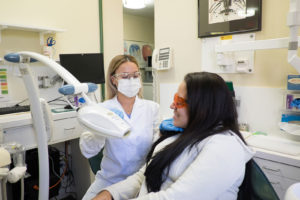 In-office tooth whitening uses a higher peroxide concentration, but it is applied with your gum tissue isolated and protected first, and desensitizing agents like potassium nitrate or fluoride varnish are used before and after treatment to calm the nerve response. Custom take-home trays from a dentist sit in between the two options: they use a professional-grade formula, but the concentration and wear time can be adjusted specifically for a patient with sensitive teeth in a way a pharmacy box simply cannot offer.
The result is that patients with a history of sensitivity or thin enamel often do better with professional treatment, even though it involves a stronger formula, because the process is controlled and protected rather than generic.
What to Do If You Have Sensitive Teeth and Want a Brighter Smile
A few adjustments make a real difference for patients who already deal with sensitivity or thin enamel:
- Start a desensitizing toothpaste one to two weeks before treatment. Formulas containing potassium nitrate help calm nerve activity ahead of time, which can reduce how much sensitivity you feel once whitening begins.
- Ask about a lower concentration formula or shorter wear time. This is something a dentist can dial in with custom take-home trays. An over-the-counter box does not offer this flexibility.
- Get evaluated before starting any whitening treatment if sensitivity is already a known issue. A dentist can check for enamel erosion, gum recession, or a cracked tooth, any of which an over-the-counter kit has no way of accounting for.
When Sensitivity Means Something More Than Normal
 Mild, short-lived zings during or right after whitening are expected. A few signs point to something beyond typical sensitivity and are worth getting checked rather than waiting out:
- Sharp pain that lingers for more than a day or two after treatment ends
- Pain that is constant rather than triggered by hot, cold, or air
- Sensitivity localized to one specific tooth rather than spread across your smile
- Any pain paired with a visible crack, chip, or gum irritation
These can point to an existing cavity, a cracked tooth, or advanced gum recession. Whitening did not cause the underlying issue, but it can make it a lot more noticeable.
Talk to a Dentist at The Dental Care Group
Whitening sensitivity comes down to how peroxide reaches the nerve of your tooth, and how much natural protection your enamel and gums provide along the way. If you already deal with sensitive teeth or thinner enamel, a pharmacy box is usually the riskier choice simply because there is no way to adjust it to your situation. Professional whitening gives your dentist control over concentration, application, and desensitizing support, so you can get a brighter smile without paying for it in discomfort.
We have three South Florida locations, Saturday appointments, and multilingual staff ready to assist in English, Spanish, Hebrew, Portuguese, Haitian Creole, and Russian. Call our Aventura dental clinic at 305-935-2797, our Pembroke Pines dental clinic at 954-430-2300, or our Fort Lauderdale dental clinic at 954-963-3706 to schedule your consultation.