

 It Might Not Have Hurt Much, But Your Tooth Is Telling You Something
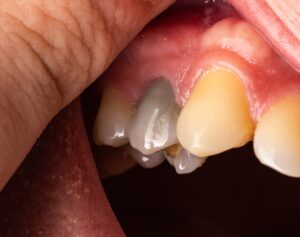
If you bumped your tooth on a mug, a countertop, or a steering wheel and walked away thinking you got lucky, you might have. But if that tooth is now darker than the ones around it, it’s giving you a signal worth paying attention to.
The good news is that a darkening tooth is not automatically a lost tooth. The bad news is that it is not something to wait on either. At The Dental Care Group, we see patients after exactly this kind of injury, and the outcome almost always depends on how quickly they come in.
If you are concerned about a tooth that has changed color after an injury, call our Aventura dental office at 305-935-2797, our Pembroke Pines dental office at 954-430-2300, or our Fort Lauderdale dental office at 954-963-3706. We offer Saturday appointments and would rather see you sooner than later.
Why Would a Tooth Turn Dark If It Did Not Really Hurt?
This is the part that surprises most people. Dental trauma does not have to be dramatic to cause real damage. A seemingly minor hit can injure the blood vessels and nerves inside the tooth, even when there is no crack, no chip, and almost no pain.
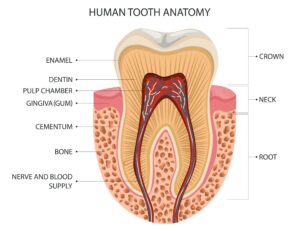
When those internal blood vessels are damaged, they can leak blood into the tiny tubules that make up the inner structure of your tooth. That blood breaks down over time and leaves behind pigment, which is what causes the darkening you are seeing in certain lighting. The tooth is essentially bruised from the inside.
This process can happen over days or even weeks after the initial injury, which is why people are often blindsided by it.
What Does a Darker-Color Tooth Actually Mean?
 Tooth discoloration after trauma usually points to one of a few things:
- Internal bleeding inside the tooth: The most common early cause. Blood enters the tooth’s inner layer, and the breakdown of that blood causes a pink, gray, or brownish tint. This does not always mean the tooth is dead, but it does mean the pulp was disturbed.
- Pulp damage or death: If the injury cuts off the blood supply to the tooth, the nerve and tissue inside the tooth can die. A gray or dark brown color, especially one that deepens over time, often indicates this.
- Early stage response: Sometimes a tooth darkens temporarily and recovers on its own if the damage was mild. You cannot tell which situation you are in without an X-ray.
The tricky part is that a tooth can look fine in regular lighting and only show the discoloration under direct flash or in certain conditions. That does not mean the problem is minor. It often just means you caught it early.
Is This a Dental Emergency?
Not the kind that sends you to the emergency room, but yes, you should be seen soon.
Teeth that have suffered internal trauma without treatment can develop infections at the root over time. Those infections do not always announce themselves with dramatic pain right away. By the time a dental abscess becomes obviously painful, it has often been developing quietly for a while, and at that point, treatment becomes more involved and more expensive.
The window where an emergency dentist can potentially save the tooth and its internal tissue is widest right after the injury. A simple X-ray can show whether the root is intact, whether there are signs of infection, and whether the nerve is likely to recover on its own or needs treatment.
What Are the Treatment Options?
 Depending on what an exam and an X-ray reveal, treatment could be straightforward or more involved. Common paths include:
- Monitoring: If the tooth shows signs of mild trauma and the structure looks intact, a dentist may recommend watching it over several appointments to see if it stabilizes and the color improves.
- Root canal therapy: If the pulp has died or shows signs of infection, a root canal removes the damaged tissue, clears any infection, and seals the tooth. This is how dentists save teeth that would otherwise be lost. It has a reputation for being painful, but most patients find the procedure itself very manageable, especially compared to an untreated infection.
- Internal bleaching: After a root canal, a darkened tooth can sometimes be lightened from the inside. This is a cosmetic option worth asking about.
- Dental crown or veneer: If the tooth’s color or structure is significantly compromised, a crown or veneer can restore both appearance and function.
What Happens If I Just Leave It?
This is a fair question, especially for anyone navigating treatment without insurance.
A tooth with a dying nerve does not always become painful right away. But left untreated, the dead tissue inside becomes a breeding ground for bacteria. Over months or years, this can develop into an abscess, bone loss around the root, and in some cases an infection that spreads beyond the tooth itself.
By the time it hurts badly enough to feel urgent, extraction may be the only option left. And once a front tooth is gone, the surrounding teeth begin to shift, the bone underneath starts to shrink, and replacing it becomes significantly more expensive than treating it would have been.
Pulling a tooth is always an option, but it is rarely the cheapest option long-term. A conversation with a dentist about payment plans and treatment priorities can often reveal a more manageable path than patients expect.
Talk to a Dentist at The Dental Care Group
A darkening tooth after trauma is your body’s way of telling you something changed inside. It does not always mean you will lose the tooth, but it does mean the tooth needs to be evaluated before that becomes the outcome by default.
We have three South Florida locations, Saturday appointments, and multilingual staff ready to assist in English, Spanish, Hebrew, Portuguese, Haitian Creole, and Russian. Call our Aventura dental clinic at 305-935-2797, our Pembroke Pines dental clinic at 954-430-2300, or our Fort Lauderdale dental clinic at 954-963-3706 to schedule your visit.